

15 Real-Life Examples of Normal Distribution

Have you ever wondered why so many things in life cluster around an average value? From human height to exam results, this tendency toward the "middle" is more than coincidence—it's a mathematical phenomenon known as the normal distribution or "bell curve." In this comprehensive guide, we’ll explore how and why the normal distribution appears everywhere, provide over 15 real-world examples, and show you how to analyze such data with Python and mathematical reasoning.
1. Why Things Cluster Around the Average
Most measurable things in the world, when influenced by many small, independent random factors, tend to form a pattern centered around the mean. This is the realm of the normal distribution, an essential concept both in statistics and in data science.
Central Limit Theorem Intuition
The Central Limit Theorem (CLT) explains why so many distributions take on the bell-shaped curve. Suppose you sum or average a large number of independent, random variables, the result will tend to be normally distributed, regardless of their original distribution:
\( \text{If } X_1, X_2, ..., X_n \text{ are i.i.d. with mean } \mu \text{ and variance } \sigma^2, \text{ then:} \)
\( \frac{\sum_{i=1}^n X_i - n\mu}{\sigma\sqrt{n}} \longrightarrow N(0, 1) \)
Why Normal Distribution Naturally Emerges
Whenever a value is the result of many minor additive effects—genetics, environment, measurement noise, timing errors, etc.—their collective impact produces the "bell curve." This explains why the normal distribution models so many real phenomena.
To see the Central Limit Theorem (CLT) in action, imagine you have a fair six-sided die. The possible outcomes from a single roll are 1 to 6, which is a uniform distribution, not a bell curve. Now, suppose you roll the die 5 times and calculate the average of those 5 rolls. If you repeat this experiment many times, each time recording the average, you'll get a sampling distribution of the mean.
At first, with just a few samples, the distribution of these averages might look irregular. But as you increase the number of samples, the histogram of the sample means starts to look more and more like a normal distribution, even though the original data (the die rolls) are not normal. For example, if you simulate 10,000 experiments of rolling 5 dice and averaging, the averages will cluster around 3.5 (the mean of a die), with fewer results far from this value. If you increase the number of dice per experiment (say, 30 dice per average), the distribution of those means becomes even smoother and more bell-shaped. This illustrates how, according to the CLT, the sampling distribution of the mean approaches normality as the sample size grows, regardless of the original distribution.

2. Visual Shape & Properties
The Famous Bell Curve
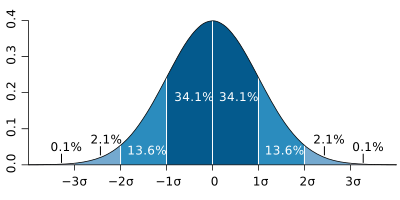
The normal distribution’s graph is symmetric and bell-shaped, centered at its mean (\(\mu\)), and its spread is determined by the standard deviation (\(\sigma\)).
Probability Density Function (PDF) Equation:
\( f(x) = \frac{1}{\sqrt{2\pi\sigma^2}} e^{-\frac{(x - \mu)^2}{2\sigma^2}} \)
Mean, Variance, and Standard Deviation
- Mean (\(\mu\)): The "average" or center of the distribution.
- Variance (\(\sigma^2\)): A measure of how spread out the data is.
- Standard deviation (\(\sigma\)): The typical distance data falls from the mean.
Empirical Rule (68–95–99.7%)
In a normal distribution:
- About 68% of values fall within one standard deviation (\(\mu \pm \sigma\)) of the mean.
- About 95% within two standard deviations (\(\mu \pm 2\sigma\)).
- About 99.7% within three standard deviations (\(\mu \pm 3\sigma\)).
3. Real-Life Normal Distribution Examples (Deep Section)
Let’s explore over 15 practical normal distribution examples, showing datasets, why they're normal, probability calculations, and Python code for each.
1. Human Height
- Dataset: Heights of adult men in the US, mean = 70 in, std dev = 3 in.
- Why Normal? Influenced by many genes, nutrition, environment—perfect for CLT.
- Example: What’s the probability that a man is taller than 73 inches?
Math:
Use the Z-score:
\( Z = \frac{X-\mu}{\sigma} = \frac{73-70}{3} = 1 \)
\( P(X > 73) = P(Z > 1) = 0.1587 \) (from standard normal tables)
from scipy.stats import norm

mean = 70
std = 3
prob_taller_than_73 = 1 - norm.cdf(73, mean, std)
print("Probability:", prob_taller_than_73)
2. Test Scores
- Dataset: SAT math scores (mean ≈ 500, std ≈ 100).
- Why Normal? Many small influences (study, education quality, environment).
- Example: What percentage scored between 400 and 600?
Math:
\( Z_{400} = \frac{400-500}{100} = -1 \)
\( Z_{600} = \frac{600-500}{100} = 1 \)
\( P(400 \lt X \lt 600) = P(-1 \lt Z \lt 1) \approx 68\% \)
prob_between = norm.cdf(600, 500, 100) - norm.cdf(400, 500, 100)
print("Between 400 and 600:", prob_between)
3. Measurement Errors
- Dataset: Errors in repeated length measurements (mean = 0, std dev = 0.2 mm).
- Why Normal? Many random instrumental/environmental effects.
- Example: What’s the chance an error is more than 0.5 mm?
\( Z = \frac{0.5-0}{0.2} = 2.5 \)
\( P(|X| > 0.5) = 2 \times P(X > 0.5) = 2 \times (1 - 0.9938) = 0.0124 \)
prob_error = 2 * (1 - norm.cdf(0.5, 0, 0.2))
print("Probability error > 0.5mm:", prob_error)
4. IQ Scores
- Dataset: Standardized IQ, mean = 100, std dev = 15.
- Why Normal? IQ tests are designed (by construction) to yield a normal distribution.
- Example: What fraction have IQ above 130?
\( Z = \frac{130-100}{15} = 2 \)
\( P(X > 130) = 1 - 0.9772 = 0.0228 \)
prob_iq_130 = 1 - norm.cdf(130, 100, 15)
print("Probability IQ > 130:", prob_iq_130)
5. Financial Returns (Approximate)
- Dataset: Daily log-returns of S&P 500 (mean ≈ 0.0005, std ≈ 0.01).
- Why Normal? Aggregation of many tiny market-moving trades and news events.
- Note: Real data may have "fat tails," but normal is often a first approximation.
- Example: Probability daily return below -2%?
\( Z = \frac{-0.02-0.0005}{0.01} \approx -2.05 \)
\( P(X < -0.02) = 0.0202 \)
prob_loss = norm.cdf(-0.02, 0.0005, 0.01)
print("Probability daily loss > 2%:", prob_loss)
6. Blood Pressure
- Dataset: Systolic blood pressure (mean = 120 mmHg, std = 12 mmHg)
- Why Normal? Influenced by genetics, diet, stress, and measurement error.
- Example: What's the probability someone's pressure is over 140?
\( Z = \frac{140-120}{12} = 1.67 \)
\( P(X > 140) = 1 - 0.9525 = 0.0475 \)
prob_high_bp = 1 - norm.cdf(140, 120, 12)
print("Probability >140 mmHg:", prob_high_bp)
7. Machine Manufacturing Errors
- Dataset: Cylindrical part diameters (mean = 10.00 mm, std = 0.05 mm)
- Why Normal? Random small errors in machines add up.
- Example: What's the chance a part is out of spec if limits are 9.90 to 10.10 mm?
\( Z_{lo} = \frac{9.90-10.00}{0.05} = -2 \)
\( Z_{hi} = \frac{10.10-10.00}{0.05} = 2 \)
\( P(9.90 < X < 10.10) = P(-2 < Z < 2) = 0.954 \)
prob_in_spec = norm.cdf(10.10, 10.00, 0.05) - norm.cdf(9.90, 10.00, 0.05)
print("In-spec probability:", prob_in_spec)
8. Noise in Electronics
- Dataset: Thermal noise voltage in resistors (centered, small std dev)
- Why Normal? Arises from many tiny, random electron collisions.
- Example: Probability noise exceeds certain microvolt level?
Analyze with the same normal probability calculations as above
9. Reaction Times
- Dataset: Human reaction time in a driving simulation (mean = 250 ms, std = 30 ms)
- Why Normal? Many physiological factors add up.
- Example: Chance of reaction time below 200 ms?
\( Z = \frac{200-250}{30} = -1.67 \)
\( P(X < 200) = 0.0475 \)
prob_fast = norm.cdf(200, 250, 30)
print("Probability reaction < 200ms:", prob_fast)
10. Measurement of Light Intensity
- Dataset: Photodetector readings under constant light (mean = μ, std = σ)
- Why Normal? Sensor and photon shot noise adds together.
- Example: Calculate chance a reading is 1σ above mean.
\( P(X > \mu + \sigma) = 1 - 0.8413 = 0.1587 \)
prob_higher = 1 - norm.cdf(1, 0, 1)  # Using Z = 1 standard deviation
print("Probability >1 std above mean:", prob_higher)
11. Shoe Size (Adults)
- Dataset: Adult men’s shoe size (US), mean ≈ 10, std ≈ 1.5
- Why Normal? Reflects overall body size, thus sum of many factors.
- Example: Probability of size 13 or larger?
\( Z = \frac{13-10}{1.5} = 2 \)
\( P(X > 13) = 0.0228 \)
prob_big_shoe = 1 - norm.cdf(13, 10, 1.5)
print("Probability shoe size >= 13:", prob_big_shoe)
12. Exam Completion Times
- Dataset: Time to finish a standard test (mean = 50 min, std = 5 min)
- Why Normal? Variation due to preparation, speed, anxiety, etc.
- Example: Probability of finishing in less than 40 min.
\( Z = \frac{40-50}{5} = -2 \)
\( P(X < 40) = 0.0228 \)
prob_quick = norm.cdf(40, 50, 5)
print("Probability < 40 min:", prob_quick)
13. Wheat Kernel Weights
- Dataset: Weight per kernel (mean = 40 mg, std = 2 mg)
- Why Normal? Many random biological and environmental factors
- Example: Probability of kernel over 44 mg?
\( Z = \frac{44-40}{2} = 2 \)
\( P(X > 44) = 0.0228 \)
prob_heavy_kernel = 1 - norm.cdf(44, 40, 2)
print("Probability weight > 44mg:", prob_heavy_kernel)